PayoffPilot blog
Snowball or Avalanche: Which Debt Payoff Method Fits You?
Two ways to pay off debt, one example with real-looking numbers, and how to find out which one fits you.
By Raul C. Peña ·
 PayoffPilot
Plan your way out of debt.
Snowball vs. Avalanche, with your real numbers.
If you’re comparing debt snowball vs avalanche, the key difference is simple: both methods put extra money toward one debt at a time, but they choose different debts first. Snowball starts with the smallest balance. Avalanche starts with the highest interest rate.
Say you have an extra $200 this month. You owe $450 on a store card at 12%, and $4,000 on a credit card at 27%. Where does the $200 go?
These numbers are made up, just to have something to look at.
That one question is the heart of the snowball-versus-avalanche decision.
What both methods agree on
You keep making the minimum payment on every debt. The extra $200 is the part you direct toward a payoff target. Both methods focus that extra on one debt at a time; they just choose a different target.
When you pay off that debt, you can roll the amount you were paying toward it into the next one. That helps your total debt-payment budget keep working through the plan instead of disappearing when one balance reaches zero.
The basic steps are:
- Pay at least the minimum due on every debt.
- Put your extra payoff money toward one target debt.
- Once it’s paid off, move that payment toward the next target.
If you’re unsure how a lender applies extra payments, check its terms or contact the lender. Keep making minimums by their due dates while you follow either strategy.
Snowball: knock out the small one
With the snowball method, you order debts from the smallest balance to the largest. In the example, that means sending the extra $200 to the store card because its $450 balance is smaller.
It could be gone in a couple of months. Then the money you were putting toward it rolls over to the next debt.
The payoff is partly practical and partly about motivation. One bill disappears. There’s one less balance to track, and you can see progress. For a lot of people, that visible win makes it easier to keep going.
The trade-off is that a smaller debt may have a lower interest rate than another balance. If so, paying it first can mean the higher-rate debt keeps accruing interest for longer.
Avalanche: go after the expensive one
With the avalanche method, you order debts from the highest interest rate to the lowest. In the example, the extra $200 goes to the credit card at 27%, because that’s the highest rate.
Using the rates in this made-up example, the $4,000 card costs around $90 a month in interest. The $450 store card costs about $4.50. The exact amount can vary with payment timing, new charges, and how the lender calculates interest, but the difference shows why the higher-rate balance is the avalanche target.
Avalanche is generally the cheaper approach on paper because it tackles the debt charging the most interest first. The catch is that the first debt may take longer to clear, so your first payoff can feel further away.
That basic distinction is also described in Fidelity’s comparison of the debt snowball and avalanche methods: snowball prioritizes balance size, while avalanche prioritizes interest rate.
Two people, two answers
These examples are made up, but you may recognize the situations.
The one who needs a win. A few things are stacked up: a $600 medical bill, a $1,200 furniture store card, and a $5,500 car loan. Money is tight, and every month feels the same. Snowball may fit here. Clearing the $600 bill first gives this person a visible sign that the plan is working, and that proof could be what gets them to month four.
The one with a big card and a steady paycheck. There’s a credit card at 24% with $8,000 on it, a $3,500 student loan at 5%, and a small $300 card at 15%. The paycheck is steady, and the main concern is watching interest pile up. Avalanche may fit here. The 24% card is where the money leaks, so that’s where the extra goes first, even if the small card sits there a while longer.
Neither person is doing it wrong. They’re choosing a method to solve a different challenge: one needs visible progress, and the other wants to focus on the costliest balance.
So which method fits you?
If you’re motivated by minimizing interest, avalanche is a reasonable place to start. If seeing a debt disappear helps you stay with your plan, snowball may be a better fit.
A plan you follow is more useful than a theoretically cheaper plan you drop in month three. And you don’t have to settle the question by guesswork. The difference between methods depends on your balances, rates, minimum payments, and monthly budget. When rates are similar, the interest difference may be small. When rates vary more, the order can matter more.
Before choosing, make sure your budget leaves room for the minimum payments on all your debts. Then consider:
- Which method would help you keep making payments consistently?
- Would paying off a small balance give you useful momentum?
- Is reducing interest your main priority?
- Do you want to compare the estimated payoff time as well as the interest?
There’s no need to treat the choice as permanent. If your priorities change, you can review your plan and choose a different target order.
Try it on your numbers
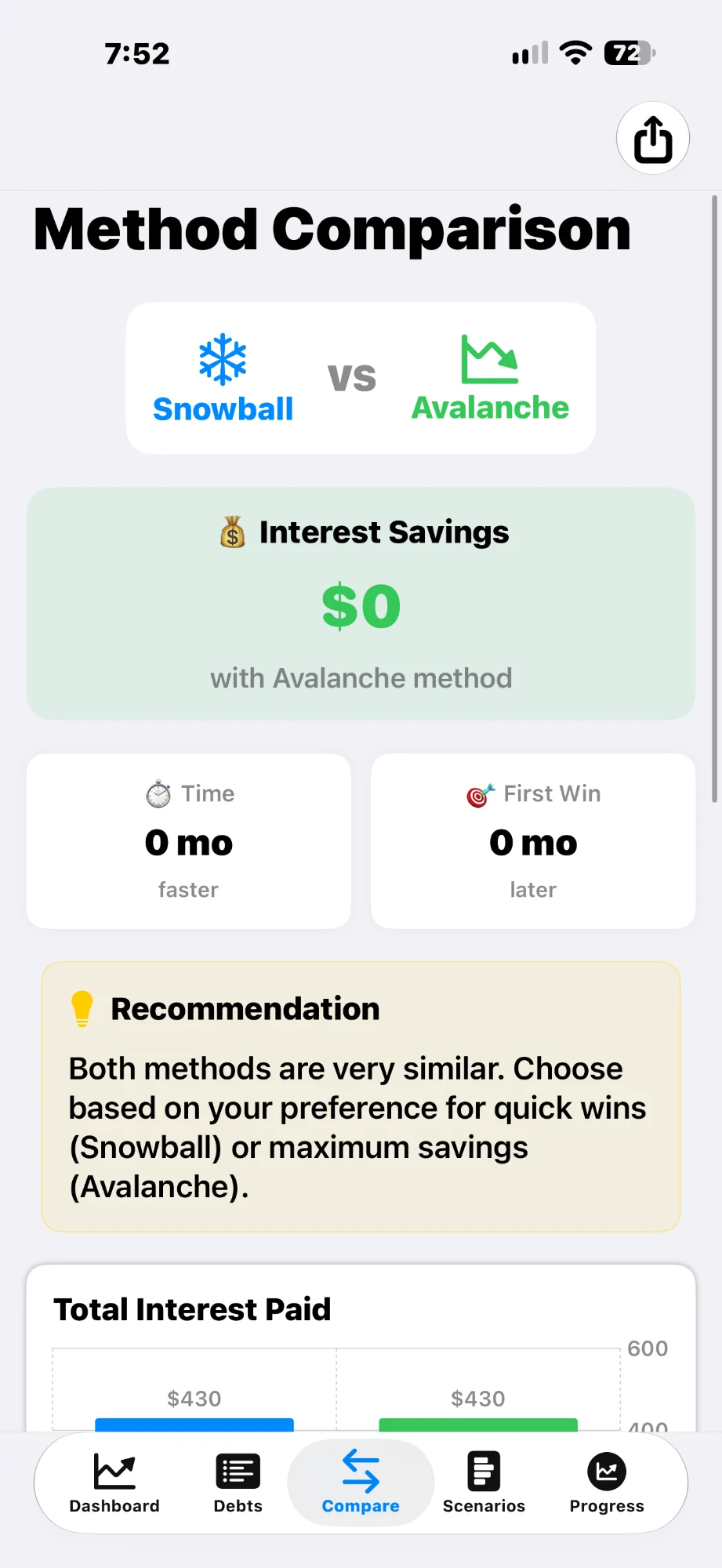
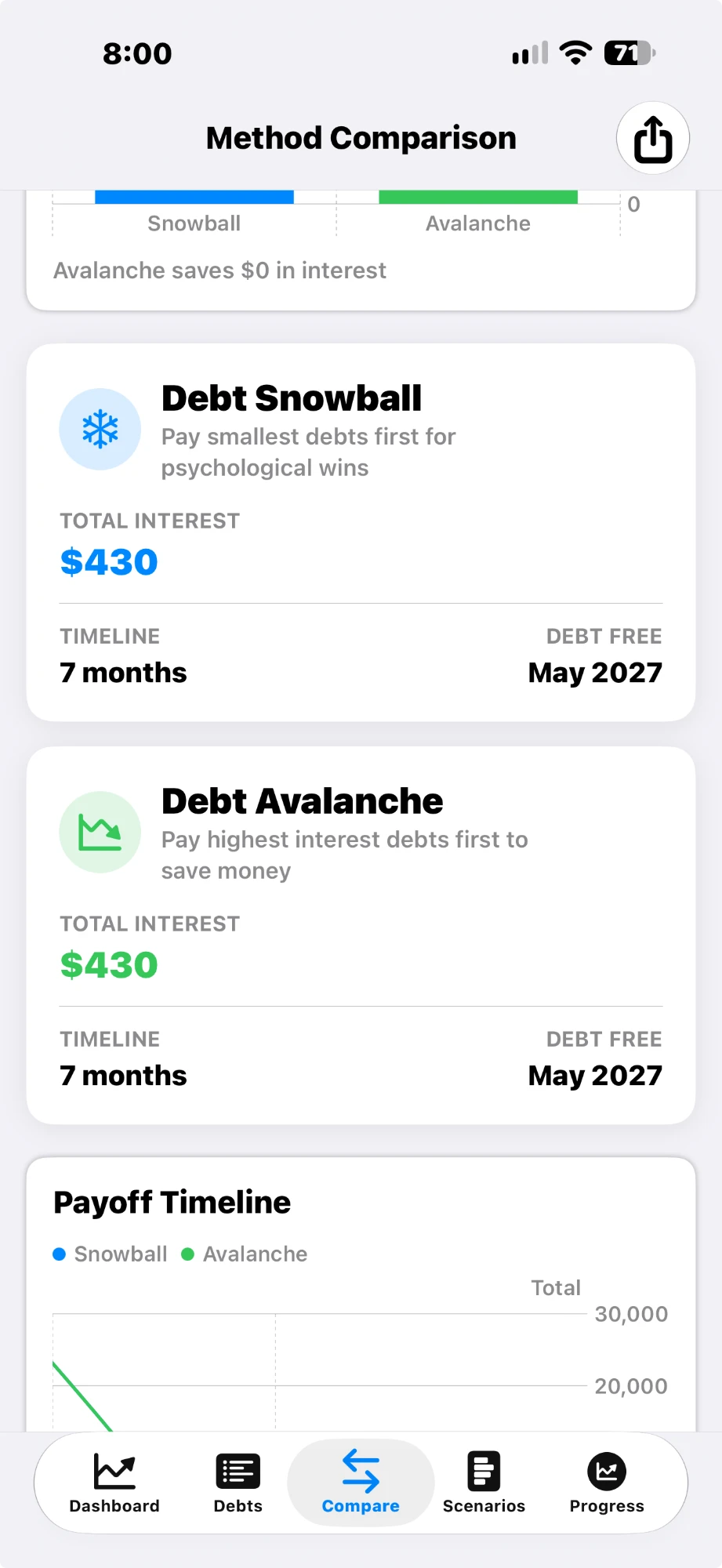
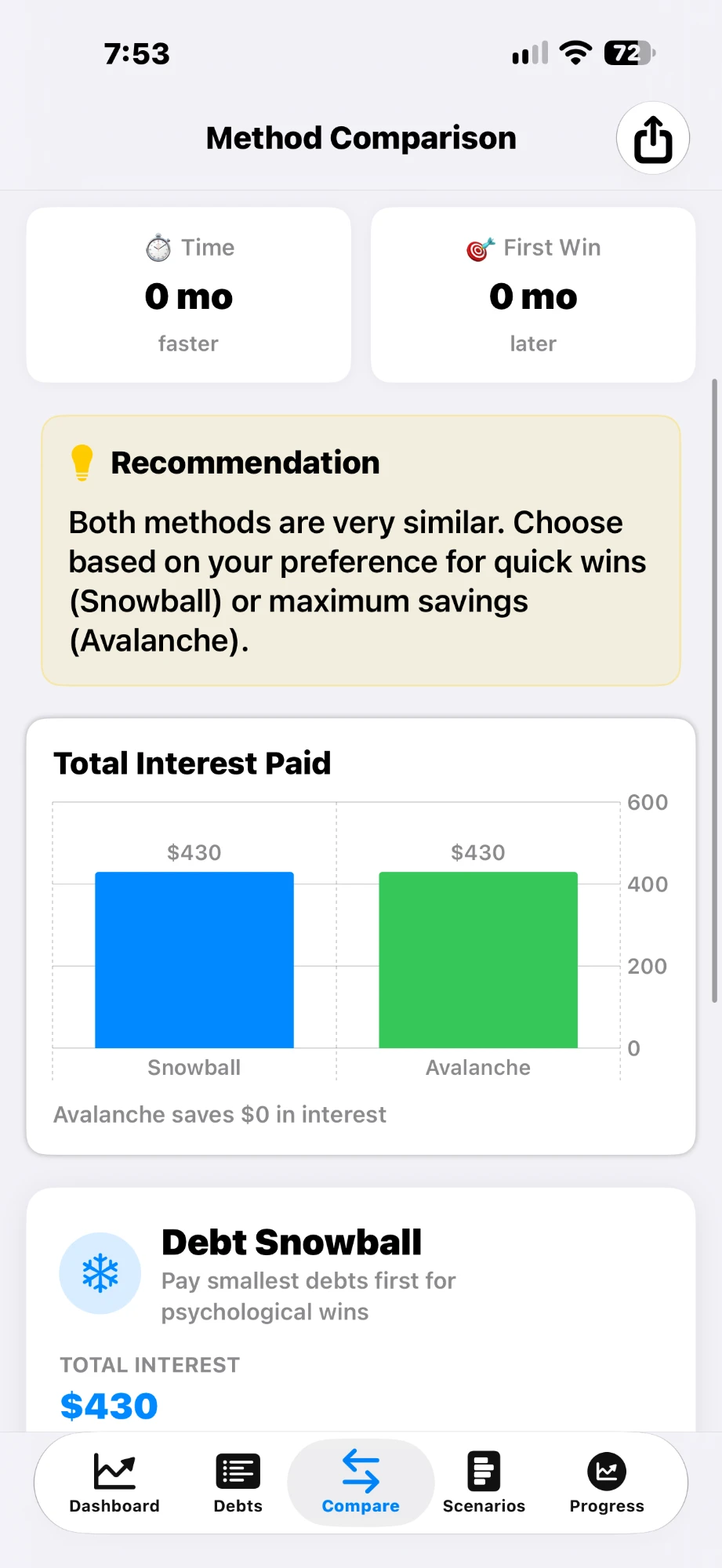
Add your debts and monthly budget to PayoffPilot, then open the Compare tab. It shows the snowball and avalanche plans side by side, including the estimated difference in interest and payoff time. If the results are close, that can make the decision simpler: choose the approach you’re more likely to stick with.
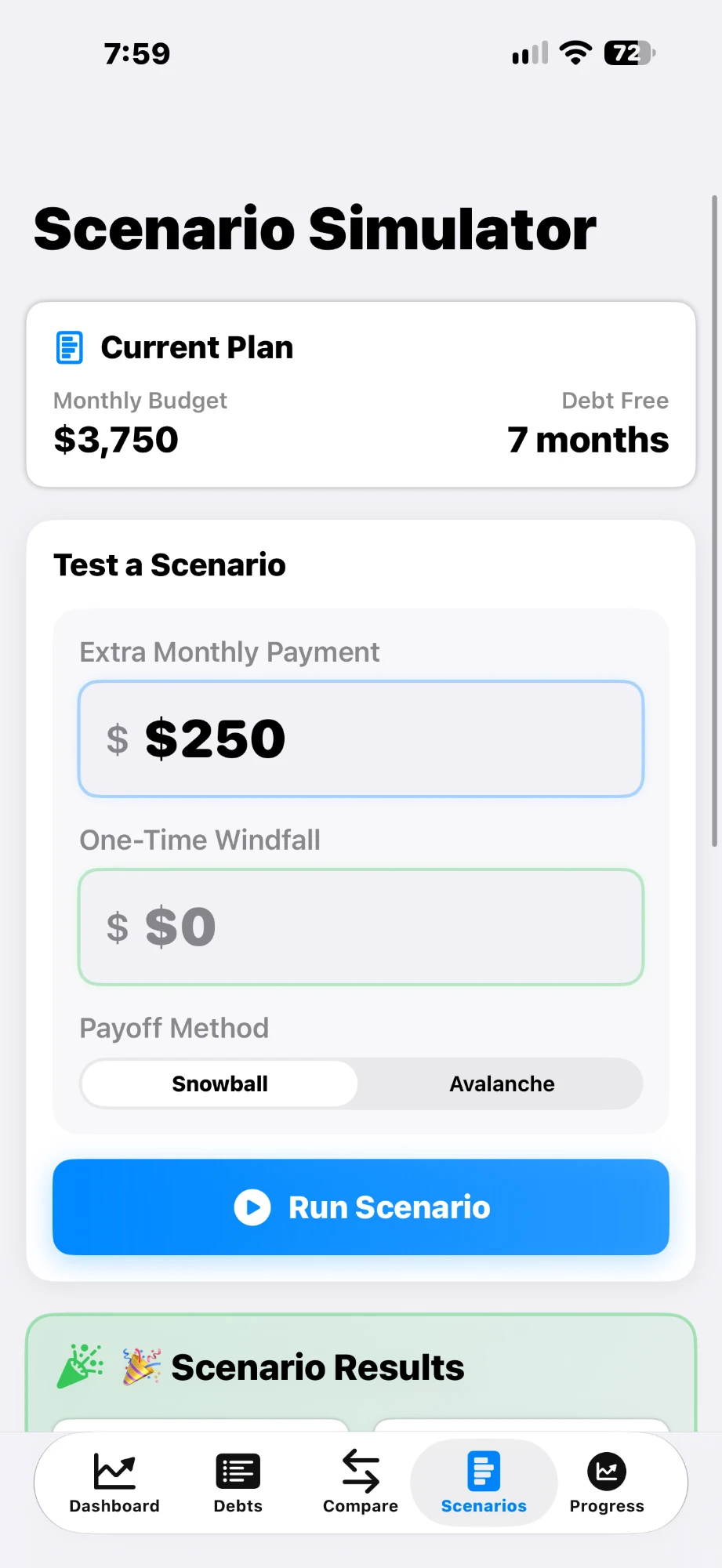
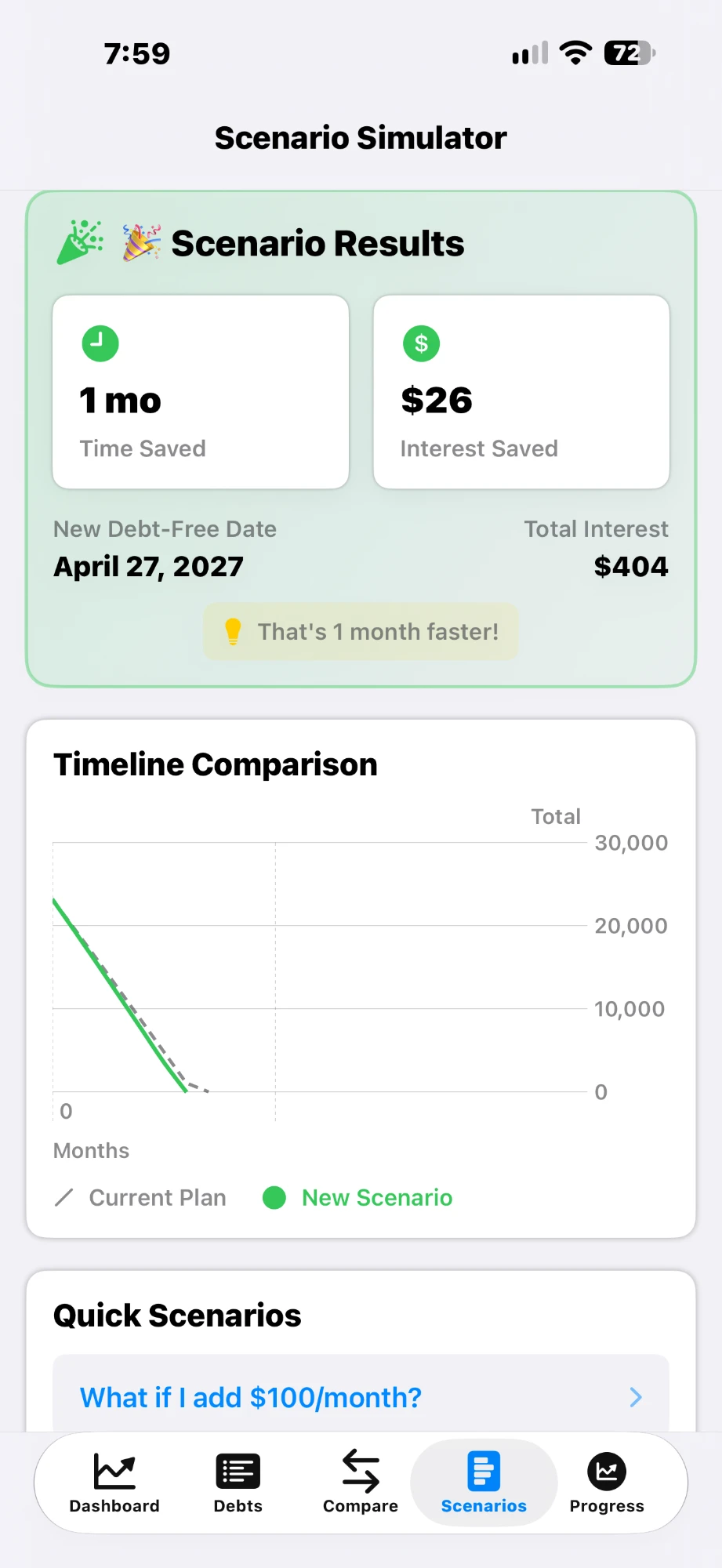
If you have PayoffPilot Pro, the Scenario Simulator goes a step further. Enter an extra monthly payment or a one-time windfall, run the scenario, and see how much time and interest it could save. With an extra $250 a month on this set of sample debts, the app showed one month saved and $26 less interest.
For a walkthrough of where to find the comparison, read the Snowball vs. Avalanche guide. You can also review the Consumer Financial Protection Bureau’s debt-reduction guide, which covers the two payoff approaches and ways to organize a plan.